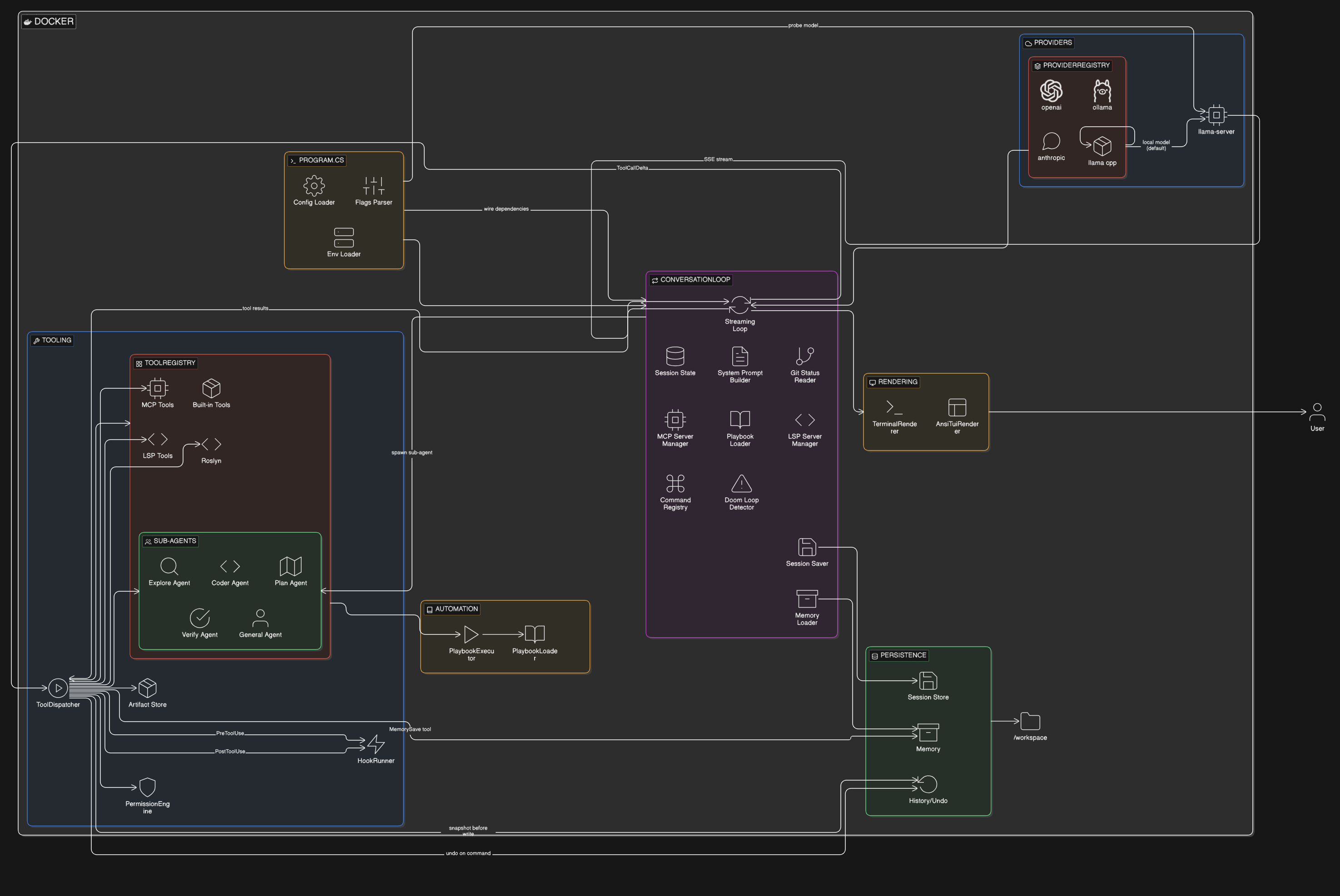
# Architecture
OpenMono is a .NET 10 CLI that runs a local agentic loop against a llama.cpp inference server (or any OpenAI-compatible endpoint). Everything runs in Docker — your project folder bind-mounts in as `/workspace`, the agent can't escape it.
---
## High-level topology
```
┌────────────────────────────────────────┐
│ openmono (CLI) │
│ src/OpenMono.Cli/ │
│ │
│ ConversationLoop │
│ └── ILlmClient (streaming SSE) │
│ └── ToolDispatcher │
│ └── 20 built-in tools │
│ └── MCP tools (dynamic) │
│ └── LSP tools │
│ └── RoslynTool │
│ └── PermissionEngine │
│ └── SessionManager (JSONL) │
│ └── Compactor / Checkpointer │
│ └── HookRunner │
│ └── IRenderer (TUI | Classic) │
└────────────────────────────────────────┘
│ HTTP :7474 (OpenAI-compat)
▼
┌────────────────────┐
│ llama-server │
│ (llama.cpp) │
│ Qwen3.6 GGUF │
└────────────────────┘
```
---
## Startup sequence (`Program.cs`)
1. Parse CLI flags (`--tui`, `--classic`, `--endpoint`, `--model`, `--verbose`, …)
2. Probe the LLM server — tries `/props` (llama.cpp), falls back to `/v1/models` — to detect the live model name and context size
3. Create `SessionState` (12-char UUID, timestamp, empty message list)
4. Wire DI: config → renderer → permissions → memory → hooks → LSP/MCP managers → playbook registry → tool registry → LLM client
5. Choose renderer: `UseTui ?? (!Console.IsInputRedirected && !Console.IsOutputRedirected)` — TUI by default for interactive terminals
6. Launch `ConversationLoop.RunAsync()`
---
## Conversation loop (`ConversationLoop.cs`)
### Initialisation (once)
- Build system prompt: base instructions + project `OPENMONO.md` + cross-session memory + git branch/status
- Start LSP servers, MCP servers, load playbooks, register commands and hooks
### Per-turn flow
```
User input
│
├─ /command → CommandRegistry.Execute()
│
└─ message
│
├─ Checkpoint if >65% context used (LLM-generated summary, preferred)
├─ Compact if >80% context used (fallback — summarise + keep last 4 turns)
│
└─ Stream LLM (up to 25 iterations)
│
├─ ThinkingDelta → thinking panel (collapsed on first text)
├─ TextDelta → streamed to output
├─ ToolCallDelta → accumulated, dispatched after stream ends
└─ Usage → token counter
│
└─ Tool execution (see below)
│
└─ Results added to session → next LLM iteration
```
Turn ends when the LLM produces text with no tool calls. Session saved to JSONL.
**Doom loop detection**: 3 identical tool call sequences in a row → abort.
---
## Tool execution pipeline
Every tool call goes through this pipeline before touching anything:
```
1. Parse JSON arguments
2. Schema validation (required fields, types, enums)
3. Sanity check (e.g. path outside workspace → reject)
4. Plan mode guard (read-only tools only when in plan mode)
5. Capability check → PermissionEngine
├─ Auto-allowed (FileRead, Glob, Grep, …)
├─ Config rules (allow/deny regex patterns per tool)
└─ Interactive (prompt user → once / session / deny)
6. Result cache lookup (read-only tools)
7. Pre-tool hook
8. Execute
9. Post-tool hook
10. Artifact store (>10 KB results → stored, reference returned to model)
11. Cache write
12. File cache invalidation (FileWrite/FileEdit/ApplyPatch)
```
**Concurrency**: read-only + concurrency-safe tools run in parallel (`Task.WhenAll`). Writable tools run serially. Read-only tasks can start while the LLM is still streaming.
## Session & context management
### Persistence (`SessionManager`)
- Format: JSONL — line 1 is a header record, subsequent lines are messages
- Path: `~/.openmono/sessions/{date}_{sessionId}.jsonl`
- Checkpoints stored alongside: `{sessionId}.checkpoints.json`
### Context window management
| Threshold | Action |
|-----------|--------|
| 65% | **Checkpoint** — LLM summarises messages up to N recent turns; summary stored with cutoff index; future context window starts from cutoff |
| 80% | **Compact** (fallback) — summarise all messages except last 4 turns; replace with summary message + recents |
The CLI reads the actual context size from `/props` at startup, so both thresholds track the real window.
---
## Sub-agents (`AgentTool`)
Spawns an isolated session with a restricted tool set and a dedicated system prompt. Parent session's permission engine is reused.
| Agent | Max turns | Allowed tools | Purpose |
|-------|-----------|---------------|---------|
| `general-purpose` | 25 | all | generic tasks |
| `Explore` | 15 | FileRead, Glob, Grep, MCP | read-only discovery |
| `Plan` | 10 | + TodoWrite (no writes) | architecture planning |
| `Coder` | 30 | FileRead/Write/Edit, Glob, Grep, Bash | implementation |
| `Verify` | 20 | FileRead, Glob, Grep, Bash, Roslyn, LSP, MCP | adversarial testing |
Tool allow-lists support wildcards (`*`, `mcp__*`).
---
## MCP client (`McpServerManager` + `McpClient`)
On startup, for each enabled MCP server in config:
1. Spawn subprocess (command + args + env)
2. JSON-RPC 2.0 handshake over stdin/stdout (`initialize` → `notifications/initialized`)
3. `tools/list` → get tool definitions
4. Register each tool as `mcp__{serverName}__{toolName}` in `ToolRegistry`
`McpClient` serialises requests, reads responses, and exposes `CallToolAsync`, `ListResourcesAsync`, `ReadResourceAsync`.
**Auto-detected servers**: `code-review-graph` (if in PATH + graph DB exists) and `graphify` (if in PATH + `graphify-out/graph.json` exists) are registered automatically without config.
---
## LSP client (`LspServerManager` + `LspClient`)
Language servers start lazily on first call. File extension → language mapping:
| Extension | Server |
|-----------|--------|
| `.cs` | OmniSharp |
| `.ts` / `.tsx` | typescript-language-server |
| `.py` | pylsp |
| `.go` | gopls |
| `.rs` | rust-analyzer |
`LspTool` exposes: `hover`, `definition`, `references`, `completion`, `diagnostic`.
---
## Roslyn tool (`RoslynTool`)
Loads all `.cs` files from the working directory into an in-memory `AdhocWorkspace` with .NET runtime metadata references. Compilation is cached for 5 minutes.
Actions:
| Action | What it returns |
|--------|-----------------|
| `overview` | Types and members in a file |
| `find-references` | Every usage of a symbol |
| `callers` | Methods that call a given method |
| `diagnostics` | Compiler errors and warnings |
| `search` | Symbols matching a name pattern |
| `type-hierarchy` | Base types, interfaces, derived types |
| `blast-radius` | Direct + transitive dependents |
| `get-symbol` | Kind, type, parameters, modifiers, location |
---
## Permissions (`PermissionEngine`)
**Capability system (primary)** — tools declare what they need:
| Capability | Example |
|------------|---------|
| `FileReadCap(path)` | read a file |
| `FileWriteCap(path, op)` | write / create / delete |
| `ProcessExecCap(binary, args)` | shell execution |
| `NetworkEgressCap(host, port)` | HTTP/HTTPS call |
| `VcsMutationCap(repo, op)` | git write |
| `AgentSpawnCap(type, task)` | spawn sub-agent |
Decision order: session deny-all → config deny patterns → session allow-all → config allow patterns → **interactive prompt** (allow once / session / deny once / session).
**Legacy system (fallback)** — tools declare `PermissionLevel`: `AutoAllow`, `Ask`, or `Deny`.
---
## Hooks (`HookRunner`)
Bash scripts triggered at three points. Conditions can filter by tool name or input substring.
```jsonc
// settings.json
{
"hooks": {
"preToolUse": [
{
"if": { "tool": "Bash", "inputContains": "rm" },
"run": "echo '{{tool_name}}: {{tool_input}}' >> audit.log"
}
]
}
}
```
Hook types: `SessionStart`, `PreToolUse`, `PostToolUse`. Timeout: 30 s each.
---
## Rendering
`IRenderer` is a composite interface: `IOutputSink` (write markdown, tool events) + `IInputReader` (read input, show pickers) + `ILiveFeedback` (stream text, thinking panel, tok/s indicator).
| Implementation | Mode | When used |
|----------------|------|-----------|
| `AnsiTuiRenderer` | Full-screen (Spectre.Console) | Interactive terminal |
| `TerminalRenderer` | Scrolling REPL | Redirected I/O or `--classic` |
The TUI is powered by [Spectre.Console](https://spectreconsole.net) — a cross-platform .NET library for building rich terminal UIs with colors, tables, progress bars, and interactive components.
---
## Key types (reference)
```csharp
interface ITool
{
string Name { get; }
string Description { get; }
JsonElement InputSchema { get; }
bool IsConcurrencySafe { get; }
bool IsReadOnly { get; }
Task ExecuteAsync(JsonElement input, ToolContext ctx, CancellationToken ct);
PermissionLevel RequiredPermission(JsonElement input);
IReadOnlyList RequiredCapabilities(JsonElement input);
}
interface ILlmClient
{
IAsyncEnumerable StreamChatAsync(
IReadOnlyList messages,
JsonElement? tools,
LlmOptions options,
CancellationToken ct);
}
// Messages
record Message(MessageRole Role, string? Content,
List? ToolCalls, string? ToolCallId, string? ToolName);
record ToolCall(string Id, string Name, string Arguments); // Arguments = JSON string
// Streaming
record StreamChunk
{
ThinkingDelta? Thinking;
TextDelta? Text;
ToolCallDelta? ToolCall;
Usage? Usage;
bool IsComplete;
}
```
---
## Project layout
```
src/OpenMono.Cli/
├── Program.cs entry point, DI wiring, startup sequence
├── Session/ ConversationLoop, SessionManager, Compactor, Checkpointer, TokenTracker
├── Tools/ 20 built-in tools + ToolRegistry, ToolDispatcher, SchemaBuilder
├── Llm/ ProviderRegistry, AnthropicClient, OpenAiCompatClient, OllamaClient
├── Permissions/ PermissionEngine, Capability, PermissionLevel
├── Agents/ AgentDefinition, AgentTool (sub-agent runner)
├── Mcp/ McpClient, McpServerManager, McpToolAdapter
├── Lsp/ LspClient, LspServerManager, LspTool
├── Roslyn/ RoslynTool (AdhocWorkspace, 8 actions)
├── Playbooks/ PlaybookExecutor, PlaybookLoader, TemplateEngine, ParameterValidator
├── Commands/ 14 slash commands (/help, /status, /model, /compact, /undo, …)
├── Memory/ Cross-session memory (YAML frontmatter files)
├── History/ File snapshots for /undo
├── Hooks/ HookRunner, HookDefinition
├── Rendering/ AnsiTuiRenderer, TerminalRenderer, IRenderer
├── Config/ AppConfig, multi-source loader
└── Utils/ Git, process, path helpers
```